
Background
Ghana
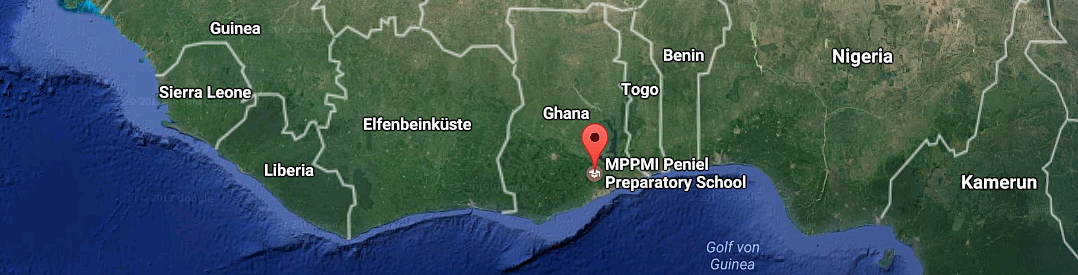
One of Africa’s 57 countries, Ghana lies just north of the equator, between the Ivory Coast and Togo, and borders the Atlantic Ocean to the south.
The south of the country is characterised by rainforest, which gives way to savannah as one moves northwards.
The Ashanti, the largest ethnic group, have lived in the territory of present-day Ghana since the Middle Ages.
Following the arrival of Portuguese settlers as early as the 15th century, Ghana has experienced an eventful history.
In 1957, the Ghanaians secured independence for their country from British colonial rule.
Today, many people from neighbouring countries – including Côte d’Ivoire, Togo and Nigeria – also live in the country. The official language is English, but many tribal languages are spoken.
The population is estimated at 25 million, with around 3 million living in the capital, Accra.
Maase
90 km or a 3-hour drive north of Ghana’s capital, Accra, lies the village of Akyem Maase in the Eastern Region, a village with a population of around 3,000.
The district capital, Koforidua, is 25 km away.
In the Eastern Region, and therefore in Maase, the inhabitants generally speak Ashanti-Twi; many also speak the official language, English.
The Hardship
The people of Ghana face great hardship. They suffer from many deprivations.
The majority live from hand to mouth.
There is a lack of work, sufficient food, clean drinking water, clothing and medical care.
Life expectancy stands at 58 years. 22 per cent of the population are illiterate.
The infant mortality rate is 4.5 per cent. One in ten children does not reach the age of ten.
There are many orphans. Furthermore, many children do not grow up with their own parents. They are then raised by other relatives or strangers, who are often unable to provide the necessary care. As a result, many children are unable to attend school.
In many cases, there is little prospect of personal development or of improving their living conditions.